

Stainless steel water bottles usually need food-contact safety test reports, material compliance documents, and sometimes market-specific certifications depending on where they are sold. For the US market, buyers often check FDA-related food-contact compliance and BPA-free materials. For the EU market, buyers should consider EU food contact material requirements, LFGB testing for Germany, and REACH chemical safety. For California, Prop 65 may also apply. If the product is designed for children, additional children’s product safety requirements may be needed.
A reliable stainless steel water bottle manufacturer should help buyers understand which documents are needed for the target market, provide material information, arrange third-party testing when required, and confirm that the reports match the actual bottle, lid, silicone seal, coating, and packaging.
Why Certifications Matter for Stainless Steel Water Bottles
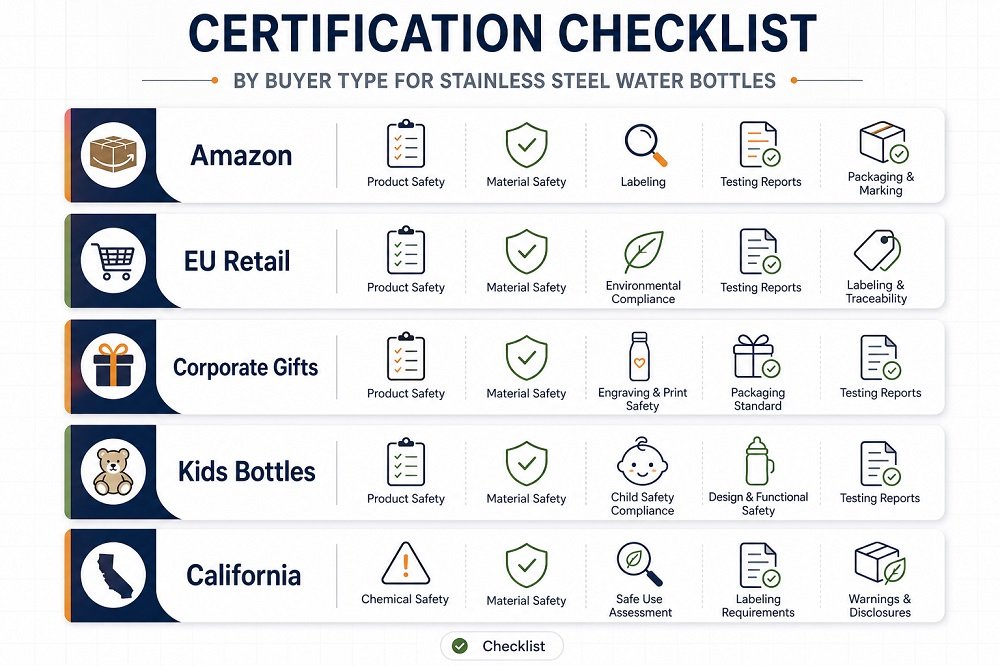
For B2B buyers, certifications and test reports are not just paperwork. They affect product safety, customs clearance, retailer approval, Amazon selling, wholesale trust, and long-term brand reputation.
A stainless steel water bottle may include several food-contact or user-contact parts:
- Stainless steel inner wall
- Outer wall
- Plastic lid
- Silicone sealing ring
- Straw
- Coating or paint
- Logo ink
- Handle
- Packaging materials
Even if the bottle body is stainless steel, the lid, straw, silicone ring, coating, and printed areas may still need testing. This is why buyers should not only ask, “Do you have FDA or LFGB?” A better question is: “Does the test report cover the exact product and materials I am ordering?”
Product Tests vs Factory Audits: Do Not Confuse Them
Many buyers mix product certifications with factory certificates. They are different.
| Type | Examples | What It Means |
|---|---|---|
| Product safety tests | FDA-related, LFGB, BPA-free, heavy metal migration | Tests the actual product or material |
| Chemical compliance | REACH, Prop 65 | Checks restricted substances or warning risks |
| Children’s product compliance | CPSIA, CPC, lead, phthalates | Applies when the product is for children |
| Factory management systems | ISO 9001 | Shows the factory has a quality management system |
| Social compliance audits | BSCI, Sedex/SMETA | Reviews labor, ethics, and social responsibility practices |
For stainless steel water bottles, product test reports are usually more important than factory certificates when the buyer is checking food-contact safety. Factory audits help evaluate supplier reliability, but they do not replace product testing.
Main Certifications and Tests by Market
| Target Market | Common Requirements or Tests | What Buyers Should Check |
|---|---|---|
| United States | FDA-related food-contact compliance, BPA-free, Prop 65 if California | Material, lid, coating, silicone, and warning risk |
| European Union | EU food contact requirements, LFGB for Germany, REACH | Migration, sensory, chemical safety, documentation |
| Germany | LFGB testing | Sensory test and material safety for food contact |
| California | Prop 65 | Whether listed chemicals may require warning |
| Kids products | CPSIA/CPC where applicable | Lead, phthalates, small parts, age suitability |
| Retail chains | Lab reports, factory audits, packaging labels | Buyer-specific compliance requirements |
Different buyers may request different documents. Amazon sellers, retail chains, promotional gift buyers, and importers often have different compliance checklists.
FDA-Related Compliance for the US Market
Many suppliers say “FDA approved water bottles,” but this wording can be misleading. In most cases, the FDA does not approve each finished water bottle as a product. Instead, materials used in food-contact applications must comply with applicable food-contact requirements.
The FDA provides information on Packaging & Food Contact Substances. For stainless steel water bottles, buyers should focus on whether the materials and components that contact drinks are suitable for food-contact use.
Ask your supplier for:
- Stainless steel material information
- Plastic lid material information
- Silicone ring material information
- BPA-free confirmation for plastic parts
- Test reports for food-contact components
- Confirmation that reports match your exact product
For US buyers, it is better to say “FDA food-contact compliant” or “FDA-related food-contact support” rather than simply “FDA approved bottle.”
EU Food Contact Requirements
For the EU market, food contact materials must comply with general EU food-contact rules. The European Commission explains that food contact materials include packaging, containers, kitchenware, and tableware, and that they must meet EU safety requirements. Buyers can refer to the official EU Food Contact Materials page.
For stainless steel bottles, buyers should check:
- Stainless steel migration safety
- Heavy metal migration
- Plastic lid compliance
- Silicone seal compliance
- Coating and paint safety
- Sensory impact on taste and smell
- Documentation from a recognized lab
The EU also has Good Manufacturing Practice requirements for food contact materials. This means buyers should choose suppliers that can control materials, production, packaging, and traceability.
LFGB Testing for Germany
LFGB is especially important for products sold in Germany. It is commonly requested for drinkware, tableware, kitchenware, and food-contact products.
For stainless steel water bottles, LFGB testing may include:
- Sensory testing for taste and odor
- Overall migration testing
- Specific migration testing
- Heavy metal release testing
- Plastic lid testing
- Silicone ring testing
- Coating or paint testing if applicable
LFGB is often considered stricter than basic food-contact checks because the sensory test is important. A bottle may be chemically safe but still fail if it affects the smell or taste of the water.
If your target market includes Germany or premium European retail, LFGB is worth considering.
REACH for Chemical Safety
REACH is an EU chemical regulation. For stainless steel water bottles, REACH may be relevant to coatings, plastic parts, silicone parts, pigments, paints, and other chemical substances used in production.
Buyers can review the European Commission’s official REACH Regulation page.
For drinkware buyers, REACH is usually not just about the stainless steel body. It may involve:
- Coating materials
- Plastic lid components
- Silicone seals
- Printed logo inks
- Color pigments
- Packaging-related materials if required by the buyer
If you sell to EU retailers, ask your supplier whether REACH testing or SVHC screening is needed for your exact product configuration.
California Proposition 65
If your stainless steel water bottles are sold in California, Prop 65 may matter. Prop 65 is not a simple “pass or fail certificate.” It is related to exposure warnings for chemicals listed by California.
Buyers can refer to the official California Proposition 65 page.
For drinkware products, Prop 65 concerns may involve:
- Lead
- Cadmium
- Certain chemicals in coatings
- Chemicals in plastic or silicone components
- Printed inks or surface finishes
If your product is sold in California, ask your supplier or testing lab whether Prop 65 testing or a warning assessment is needed.
BPA-Free Testing
BPA-free is often requested for plastic parts, not the stainless steel body itself. For stainless steel bottles, BPA-free claims usually apply to:
- Plastic lids
- Straws
- Flip caps
- Handles
- Inner plastic components
Buyers should not accept a general “BPA-free” claim without knowing which parts were tested. Ask whether the test report covers the lid, straw, and any plastic components used in the final product.
Certifications for Kids Water Bottles
If a bottle is designed or marketed primarily for children, additional safety requirements may apply. In the US, children’s products may require third-party testing and a Children’s Product Certificate depending on applicable CPSC rules. The CPSC explains its requirements on the official Children’s Product Certificate page.
For kids water bottles, buyers may need to consider:
- Lead content
- Lead in paint or coating
- Phthalates
- Small parts
- Age grading
- Physical safety
- Material safety
- Labeling requirements
If your product is a kids bottle, do not rely only on ordinary food-contact testing. Confirm children’s product requirements with a qualified lab or compliance consultant.
Factory Certificates Buyers May Ask For
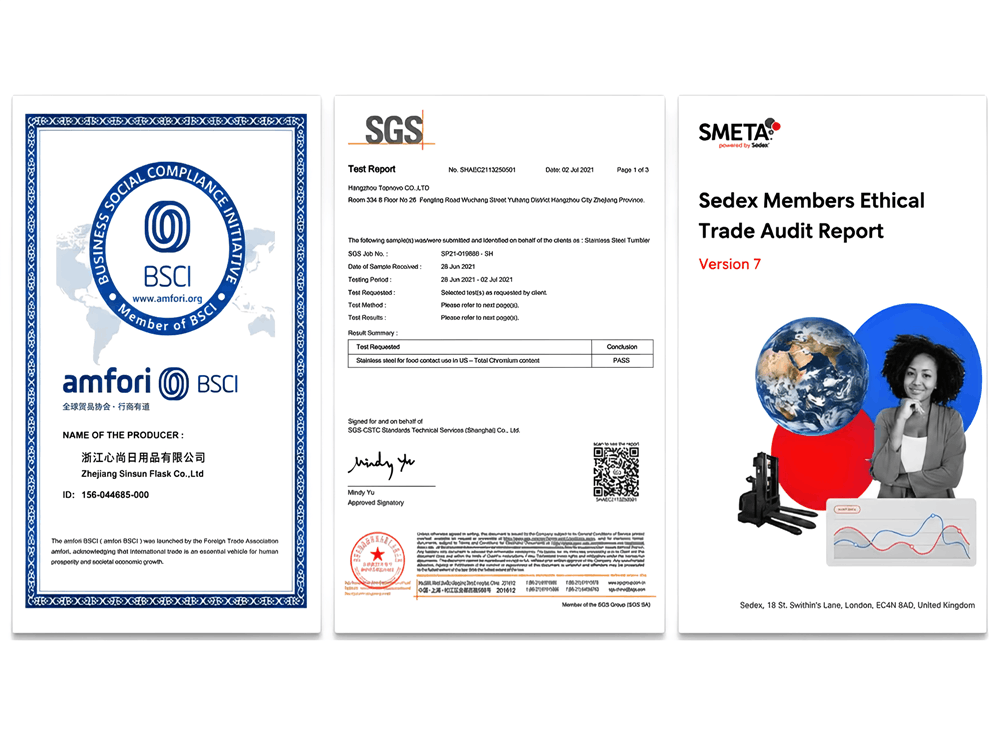
Some buyers also ask for factory certificates or social audits. These are helpful for supplier evaluation, but they are not the same as product safety reports.
Common factory-related documents include:
| Certificate or Audit | Purpose |
|---|---|
| ISO 9001 | Quality management system |
| BSCI | Social compliance and supply chain responsibility |
| Sedex/SMETA | Ethical trade and social audit |
| Factory audit report | Buyer-specific factory evaluation |
| QC process documents | Internal quality control evidence |
Topnovo’s website lists ISO 9001, FDA, BSCI, BPA Free, LFGB, and Sedex, and highlights a quality-control system with 16 full-time QC inspectors, insulation testing, leak-proof testing, salt spray corrosion testing, and coating adhesion testing. Buyers can also review Topnovo’s water bottle quality control process when evaluating production control.
What Documents Should B2B Buyers Ask Suppliers For?
Before placing a bulk order, ask for documents based on your market and product type.
| Document | Why It Matters |
|---|---|
| Material specification | Confirms stainless steel, plastic, silicone, and coating materials |
| Food-contact test report | Supports product safety for drinking use |
| BPA-free report | Important for plastic lids and straws |
| LFGB report | Important for Germany and premium EU markets |
| REACH report | Helps check restricted chemical risks in EU |
| Prop 65 report or assessment | Important for California sales |
| CPC or children’s product report | Needed if the product is for children |
| Factory audit or ISO certificate | Helps evaluate supplier management |
| Pre-shipment inspection report | Confirms bulk order quality before shipping |
Most importantly, confirm that the documents match:
- The same bottle model
- The same lid
- The same straw
- The same silicone ring
- The same coating
- The same color
- The same logo process if relevant
A test report for one model does not automatically cover another bottle.
Common Compliance Mistakes to Avoid
Many brands make compliance mistakes because they treat certifications as generic documents.
Avoid these mistakes:
- Assuming “FDA approved” means the finished bottle is approved by FDA
- Using an old report for a new bottle model
- Ignoring the lid, straw, and silicone ring
- Testing the bottle body but not the coating
- Using a report from a different color or material
- Forgetting Prop 65 for California sales
- Selling kids bottles without checking children’s product rules
- Assuming factory audits replace product testing
- Not confirming retailer-specific requirements
- Waiting until after production to arrange testing
The safest approach is to confirm testing requirements before sample approval and before mass production.
How to Verify a Test Report
Before accepting a certificate or test report, check these details:
- Lab name and accreditation
- Report date
- Applicant name
- Product description
- Model number or item number
- Material description
- Sample photos
- Test standard
- Test results
- Pass/fail conclusion
- Whether the report applies to your exact product
If you are placing a large order, ask the supplier to test your actual production sample, not only a general catalog sample.
How Topnovo Supports Compliance and Quality Control
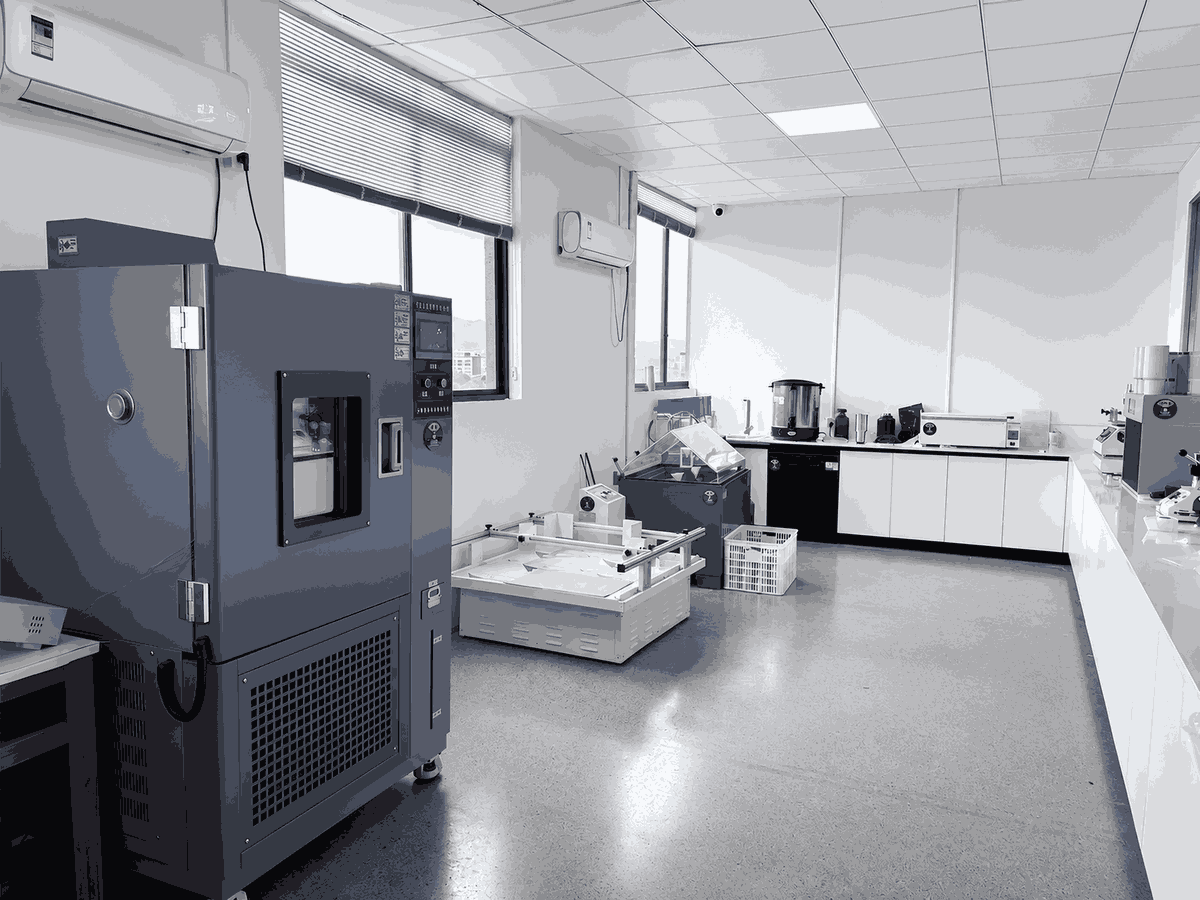
Topnovo supports brands, wholesalers, Amazon sellers, importers, and promotional buyers with custom stainless steel drinkware manufacturing.
Topnovo can support:
- Custom stainless steel water bottles
- OEM/ODM drinkware projects
- Private label production
- BPA-free component selection
- Custom logo and packaging
- Sample development
- Food-contact testing support
- Quality control
- Amazon FBA preparation
- Bulk production for global buyers
For B2B projects, compliance should be discussed early. Buyers should share the target market, sales channel, product type, lid design, packaging plan, and required documents before mass production.
FAQ
Do stainless steel water bottles need FDA certification?
For the US market, buyers usually need food-contact compliance support rather than “FDA approval” of the finished bottle. Materials that contact drinks should meet applicable food-contact requirements.
Is LFGB required for stainless steel water bottles?
LFGB is commonly requested for Germany and often used for premium EU buyers. If you sell in Germany, LFGB testing is highly recommended.
Does BPA-free apply to stainless steel bottles?
BPA-free usually applies to plastic components such as lids, straws, and caps. The stainless steel body itself does not contain BPA, but the plastic parts should be checked.
What certification is needed for kids water bottles?
Kids water bottles may require additional children’s product testing, such as lead, phthalates, small parts, and CPC-related requirements depending on the market.
Is ISO 9001 a product certification?
No. ISO 9001 is a quality management system certification. It helps evaluate factory management, but it does not replace product safety testing.
Can one test report cover all bottle models?
Usually no. A report should match the actual product, material, lid, coating, color, and components. Different models or materials may require separate testing.
Conclusion
Stainless steel water bottle certifications depend on the target market, product design, materials, and sales channel. For most B2B buyers, the key documents include food-contact test reports, BPA-free confirmation, LFGB or EU food-contact support, REACH if selling in Europe, Prop 65 assessment for California, and children’s product testing when applicable.
The most important point is not simply whether a supplier “has certificates.” Buyers should confirm whether the documents match the exact product they plan to order.
Working with an experienced manufacturer can help reduce compliance risk, avoid costly mistakes, and make bulk water bottle sourcing more reliable.
Need help confirming certifications for your stainless steel water bottle project?
Topnovo supports custom stainless steel water bottles, OEM/ODM drinkware, private label packaging, food-contact testing support, quality control, and bulk production for global B2B buyers.
Request a water bottle sample or contact Topnovo to discuss your next drinkware project.