

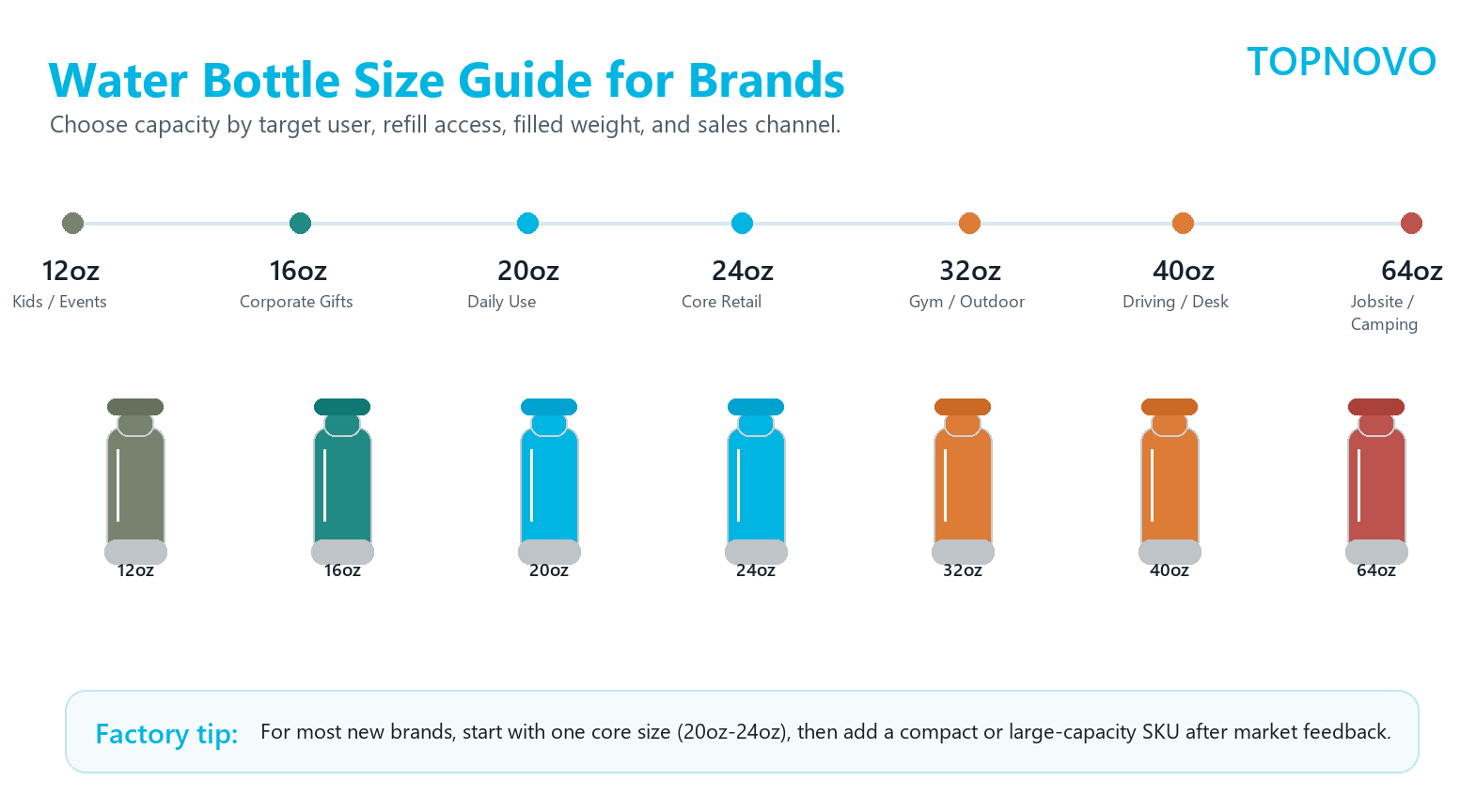
For most water bottle brands, 20oz to 24oz is the safest starting capacity because it balances portability, daily hydration, cup-holder fit, packaging cost, and retail appeal. A 12oz to 16oz bottle works better for kids, corporate gifts, events, and compact bags. A 32oz to 40oz bottle is better for gyms, outdoor use, driving, and large-capacity lifestyle products. A 64oz bottle should usually be positioned for jobsite, camping, sports sideline, or water-reserve use rather than everyday carry.
The right capacity is not simply the biggest size. It depends on your target user, refill habits, filled weight, bottle diameter, lid design, packaging volume, and sales channel.
At Topnovo, we help brands choose the right bottle capacity before sampling and bulk production, so the final product is easier to use, easier to package, and easier to sell.
Why Capacity Is a Brand Decision
When brands develop a custom water bottle, capacity often looks like a simple number: 12oz, 20oz, 24oz, 32oz, 40oz, or 64oz. In reality, that number affects almost every part of the product.
Capacity changes the filled weight, body diameter, lid choice, logo area, packaging size, carton quantity, shipping cost, and customer experience. A bottle that looks attractive when empty may feel too heavy when filled. A bottle with strong visual appeal may still fail if it does not fit a car cup holder or backpack pocket.
A good capacity decision should answer one question: Where will the customer actually use this bottle every day?
Consumer guides such as REI’s water bottle buying guide often explain capacity from a user perspective. For brands, the same decision also needs to include cost, packaging, MOQ, logistics, and retail positioning.
Common Water Bottle Capacities and Best Use Cases
| Capacity | Approx. Metric | Best For | B2B Buying Notes |
|---|---|---|---|
| 12oz | 350ml | Kids, events, small gifts | Lightweight, lower material cost, smaller logo area |
| 16oz | 473ml | Office, conference gifts, compact bags | Practical for corporate programs and giveaways |
| 20oz | 591ml | Daily use, school, gym, commuting | Strong balance between size and portability |
| 24oz | 710ml | Retail brands, wellness programs, office use | Often a good core size for everyday hydration |
| 32oz | 946ml | Gym, outdoor, desk use, fewer refills | More branding area and higher perceived value |
| 40oz | 1.18L | Driving, sports, lifestyle tumblers | Needs handle, straw lid, or strong carrying design |
| 64oz | 1.89L | Jobsite, camping, sports sidelines | Heavy when full, better for water reserve use |
For a new brand, it is usually better to start with one core size and one secondary size rather than launching too many capacities at once.
Start with the Target User
Capacity should begin with the customer, not the mold.
For office workers and corporate gifts, 16oz to 24oz usually works well. These bottles are easy to carry, suitable for desks, and practical for daily commuting.
For gym and sports users, 24oz to 32oz is often stronger. These buyers usually want fewer refills, faster drinking access, and a lid that works during movement.
For outdoor users, field workers, and long-distance drivers, 32oz to 40oz can be more attractive. However, these products need better carrying comfort, stronger lids, and stable packaging.
For kids or school programs, 12oz to 20oz is safer. A bottle that is too large may be difficult for children to carry, open, clean, or store in a backpack.
For lifestyle brands, 24oz, 32oz, and 40oz can all work, but the choice should match the brand story. A slim 24oz bottle feels clean and premium. A 40oz handled bottle feels bold, social, and trend-driven.
Consider Refill Access
A bigger bottle is not always better. If users can refill often, a smaller bottle may be more comfortable and more frequently used.
For offices, schools, gyms, hotels, and urban workplaces, refill access is usually easy. In these cases, 20oz to 24oz can be more practical than a bulky large bottle.
For construction sites, outdoor events, road trips, beach days, camping, or hiking, larger capacities such as 32oz, 40oz, or 64oz may make more sense.
A simple rule for brands:
| Refill Situation | Better Capacity Choice |
| Easy refill access | 16oz to 24oz |
| Moderate refill access | 24oz to 32oz |
| Limited refill access | 32oz to 64oz |
This helps avoid a common product mistake: choosing a large bottle for marketing appeal, then discovering that customers do not want to carry it daily.
Calculate Filled Weight
Capacity adds weight quickly. Water itself is heavy before adding the stainless steel body, lid, handle, straw, silicone parts, and packaging.
| Capacity | Approx. Water Weight Only |
| 12oz | 0.36kg |
| 16oz | 0.47kg |
| 20oz | 0.59kg |
| 24oz | 0.71kg |
| 32oz | 0.95kg |
| 40oz | 1.18kg |
| 64oz | 1.89kg |
A 40oz insulated stainless steel bottle can feel heavy once filled. A 64oz bottle may hold nearly 1.9kg of water before the bottle weight is added.
This does not mean large bottles are bad. It means they need the right use case. A large bottle works well in a car, on a desk, at the gym, or at a jobsite. It is less practical when carried by hand all day.
Check Diameter and Shape
Two bottles can have the same capacity but very different usability.
A tall, slim 24oz bottle may fit a backpack side pocket and car cup holder. A short, wide 24oz bottle may not. A 32oz bottle with a tapered base may be easier to use than a straight wide-body design.
Before confirming a custom bottle design, check:
- Base diameter
- Maximum body diameter
- Overall height
- Lid height
- Handle width
- Cup-holder fit
- Backpack pocket fit
- Carton packing size
For Amazon sellers and ecommerce brands, this matters even more. A small change in bottle diameter or height can affect individual box size, master carton quantity, pallet loading, FBA storage, and shipping cost.
If you are developing a custom stainless steel water bottle, Topnovo can help review capacity together with dimensions, lid structure, packaging, and carton planning.
Capacity vs Packaging and Shipping Impact
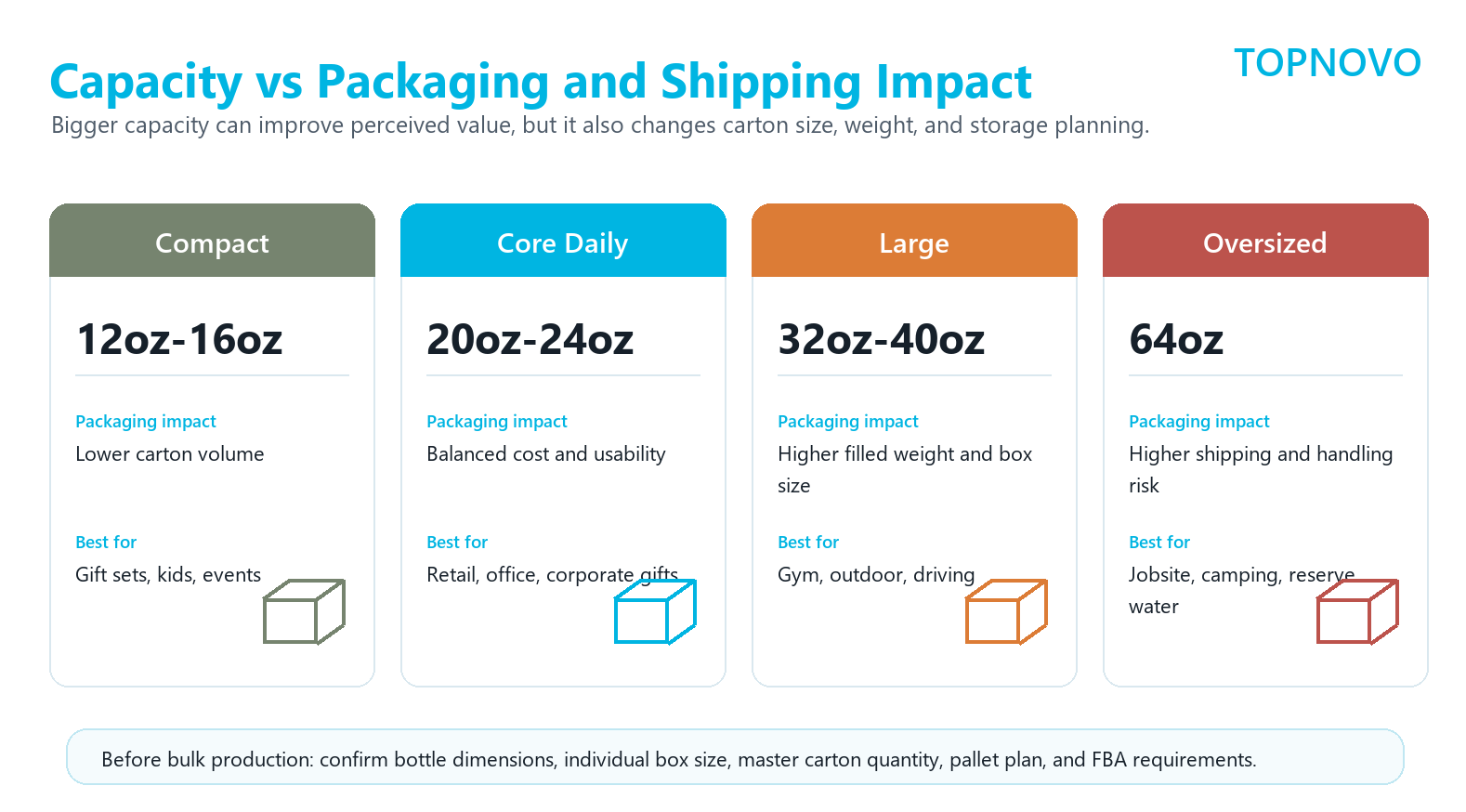
Capacity also affects logistics. A larger bottle may increase perceived value, but it may also increase packaging size, carton volume, and shipping weight.
| Capacity Range | Packaging Impact | Best For | Buyer Risk |
| 12oz to 16oz | Lower carton volume | Events, kids, gift sets | Smaller logo area |
| 20oz to 24oz | Balanced cost and usability | Retail, office, corporate gifts | Need strong product differentiation |
| 32oz to 40oz | Larger box and higher filled weight | Gym, outdoor, driving | Higher shipping and storage cost |
| 64oz | Higher handling and carton risk | Jobsite, camping, reserve water | Heavy product, narrower use case |
Before bulk production, brands should confirm the bottle size, individual box size, master carton quantity, carton weight, barcode position, pallet plan, and FBA requirements.
This is especially important when sourcing bulk water bottles from China, because capacity decisions affect both product cost and landed cost.
Match Capacity with the Right Lid
Capacity and lid design should be planned together.
A 12oz to 20oz bottle can use a screw lid, flip lid, or simple straw lid because the bottle is light and easy to handle.
A 24oz to 32oz bottle often works well with a chug lid, straw lid, handle lid, or wide-mouth lid. These capacities are common for daily hydration, gyms, schools, and outdoor activities.
A 40oz bottle usually needs a stronger carrying solution. A handle, straw lid, or comfort grip can make the product easier to use.
A 64oz bottle should not rely on appearance alone. It needs a strong handle, stable base, durable lid, and careful leak testing because the filled weight is much higher.
If you are still deciding lid types, read Topnovo’s guide on how to choose the right water bottle lid.
Think About Logo Area and Branding
Larger bottles provide more space for logos, slogans, patterns, and retail-style artwork. This can help lifestyle brands, sports teams, outdoor brands, and promotional campaigns.
However, bigger logo space does not always mean better branding. A small bottle with a clean laser engraved logo may look more premium than a large bottle with oversized artwork.
For custom logo water bottles, the capacity and decoration method should be selected together. A slim bottle may suit vertical logos. A wider bottle may work better for large front logos, full-color UV printing, or wraparound designs.
The best branded bottle is not the one with the biggest print area. It is the one customers actually carry.
Choose Capacity by Sales Channel
Different sales channels need different capacity strategies.
For Amazon sellers, 20oz, 24oz, 32oz, and 40oz are usually easier to explain in product listings. Product photos, feature bullets, and packaging size must clearly support the capacity.
For corporate gifts, 16oz to 24oz often performs well because these sizes are practical, easy to distribute, and suitable for many recipients.
For retail brands, 24oz to 32oz can be a strong core range, while 40oz can work as a trend-driven hero product.
For schools and kids programs, 12oz to 20oz is safer because filled weight, lid simplicity, and drop resistance matter more than large capacity.
For outdoor and field work, 32oz to 64oz can work, but durability, carrying comfort, and insulation performance become more important.
Recommended Capacity Strategy for New Brands
New brands should avoid launching too many capacities too early. More size options can increase mold cost, packaging complexity, inventory risk, and MOQ pressure.
A practical starting structure is:
| Product Role | Suggested Capacity | Purpose |
| Compact Size | 12oz to 16oz | Kids, events, gift sets, entry-level programs |
| Core Daily Size | 20oz to 24oz | Main retail product, office use, corporate gifts |
| Large Hydration Size | 32oz to 40oz | Gym, outdoor, driving, lifestyle trend products |
After the first production run, use sales data, customer reviews, and channel feedback to decide whether to add 64oz, kids bottles, travel tumblers, or special collections.
Before You Confirm Capacity, Ask Your Supplier These Questions
Before approving samples, brands should ask the supplier practical questions, not just request a catalog.
- What is the exact bottle height, base diameter, and maximum body diameter?
- Does this capacity fit common car cup holders or backpack pockets?
- What lid options are compatible with this capacity?
- What is the approximate filled weight with bottle, lid, and water?
- What is the individual box size and master carton quantity?
- Does the logo area work with laser engraving, screen printing, or UV printing?
- Can the factory test leak resistance, insulation, coating adhesion, and drop performance?
- Can the supplier support barcode, carton marks, pallets, and FBA packaging needs?
These questions help brands reduce risk before sampling, instead of discovering problems after bulk production.
Topnovo Capacity Selection Checklist
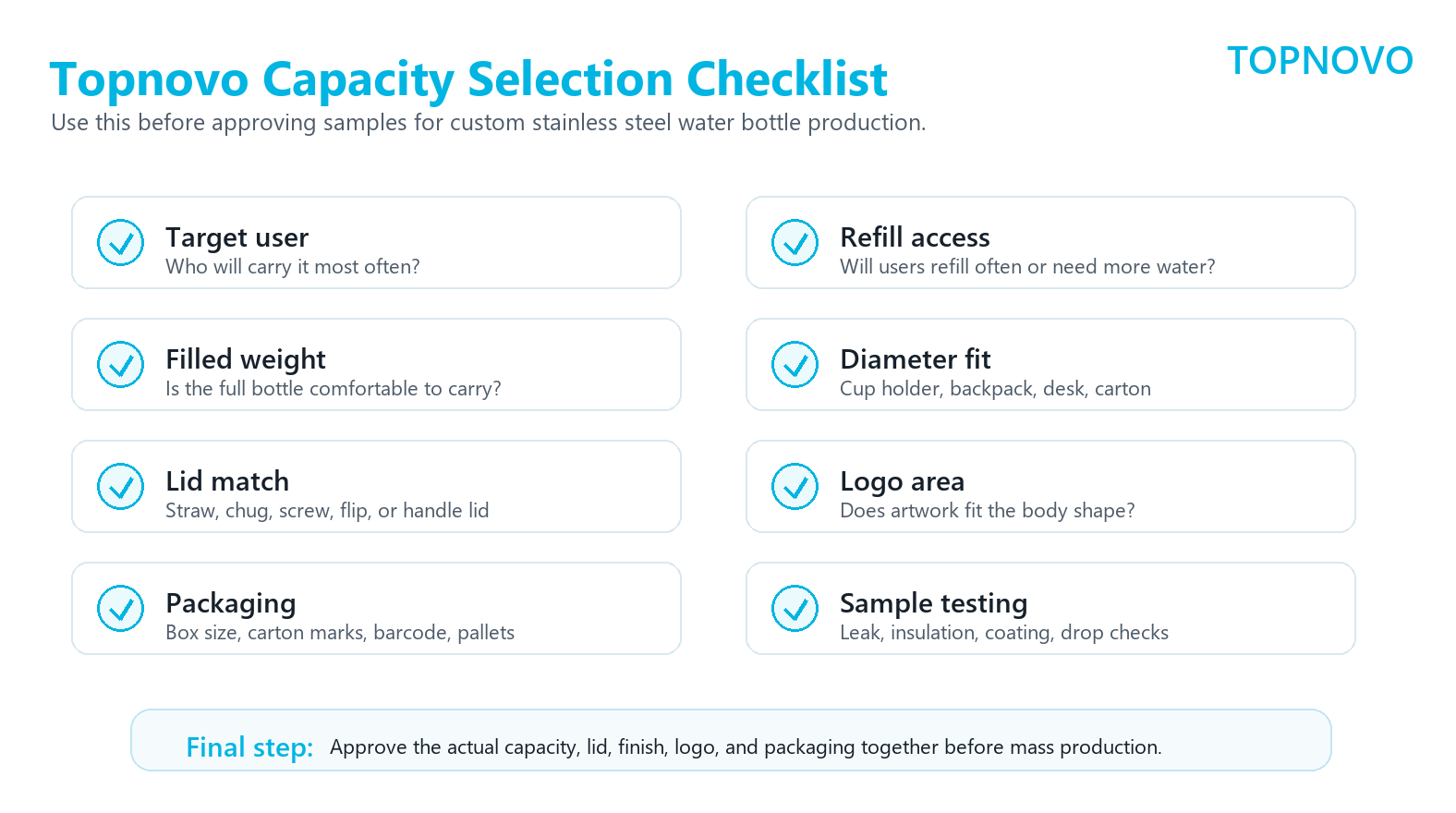
Before confirming a custom water bottle capacity, Topnovo recommends checking:
| Checklist Item | What to Confirm |
| Target user | Office, gym, outdoor, kids, corporate gifts, retail |
| Refill access | Easy refill, moderate refill, limited refill |
| Filled weight | Comfort when the bottle is full |
| Diameter fit | Cup holder, backpack pocket, desk, carton |
| Lid match | Screw, straw, chug, flip, handle, wide-mouth |
| Logo area | Logo size, artwork position, decoration method |
| Packaging | Box size, carton marks, barcode, pallet plan |
| Sample testing | Leak, insulation, coating, drop, lid durability |
This checklist makes capacity selection more practical. It also helps buyers compare different bottle models before placing a bulk order.
Topnovo supports sampling, capacity review, lid matching, surface finish testing, and water bottle quality control before shipment.
Common Capacity Mistakes Brands Should Avoid
The first mistake is choosing capacity only because it is trending. A 40oz bottle may be popular, but it may not suit every customer group or sales channel.
The second mistake is ignoring filled weight. A bottle that feels impressive when empty may become uncomfortable when full.
The third mistake is assuming capacity equals cup-holder fit. Cup-holder compatibility depends on base diameter, body shape, handle position, and lid design.
The fourth mistake is using the same lid for every size. Larger bottles need better flow rate, stronger sealing, and easier carrying.
The fifth mistake is launching too many sizes too early. More capacity options can create higher inventory pressure and slower decision-making.
The sixth mistake is approving bulk production without testing real samples. Capacity should be tested with the final lid, coating, logo, carton, and packaging.
How Topnovo Helps Brands Choose the Right Capacity
At Topnovo, we do not treat capacity as a simple number. We review it as part of the full product plan.
For custom stainless steel water bottle projects, we help buyers consider:
- Target user and market positioning
- Capacity and dimensions
- Cup-holder and backpack fit
- Lid type and drinking flow
- 304 or 316 stainless steel material
- Powder coating, spray painting, or other finishes
- Logo method and artwork area
- Packaging size and carton packing
- Amazon FBA or retail requirements
- Sample testing before bulk order
Whether you are building a new drinkware brand, preparing a corporate gift program, or sourcing bulk bottles for ecommerce, the right capacity can make the product easier to use, easier to sell, and easier to reorder.
You can request a water bottle sample from Topnovo to compare different capacities before confirming your final order.
FAQ
What is the best water bottle capacity for a new brand?
For most new brands, 20oz to 24oz is the safest core size. It is portable, familiar to buyers, easier to package, and suitable for daily use. If your brand targets fitness, outdoor, or large-capacity lifestyle products, 32oz or 40oz can be added as a second option.
Is a 32oz water bottle too large?
A 32oz bottle is not too large if the user wants fewer refills and does not need to carry it by hand all day. It works well for gyms, office desks, outdoor activities, and longer routines. However, brands should check filled weight, diameter, lid comfort, and packaging size.
Should my brand sell 40oz bottles?
A 40oz bottle can be a strong product if your market includes driving, gym, outdoor, desk use, or trend-driven lifestyle buyers. It usually needs a comfortable handle, straw lid or chug lid, stable base, and good packaging protection.
What capacity is best for corporate gifts?
For corporate gifts, 16oz to 24oz is usually the most practical range. These sizes are easy to carry, suitable for office use, and easier to distribute in bulk. A premium 24oz insulated stainless steel bottle can offer a good balance of usability and perceived value.
How do I choose between 24oz and 32oz?
Choose 24oz when portability, cup-holder fit, and daily commuting matter more. Choose 32oz when fewer refills, gym use, outdoor use, or larger branding area matters more. If your budget allows, sampling both sizes before production is the safest choice.
Final Thoughts
Choosing the right water bottle capacity is one of the most important decisions in custom drinkware development. It affects user experience, product cost, packaging, shipping, branding, and long-term customer satisfaction.
For most brands, the best starting point is simple: choose one practical core size, test it with the right lid and packaging, then expand only when your market gives you enough feedback.
If you are planning a custom water bottle project, Topnovo can help you compare capacities, confirm dimensions, test samples, and prepare your product for bulk production.